The Real Estate Hiding in Plain Sight: Why Your Back-of-House Is Costing You Revenue
Forbes Industries, with over 100 years of building mobile hospitality equipment, has engineered folding systems that collapse a full live-action setup onto a single cart. For luxury properties, it turns dead storage space into recoverable, revenue-generating square footage.
The Problem No One Puts on the P&L
Ask any general manager what their most valuable asset is, and they will point to the rooms. Ask them about their least valuable square footage, and most will not have an answer, because back-of-house storage rarely shows up in a revenue conversation at all.
It should. In a luxury property, every square foot carries a cost. Floor space dedicated to storing banquet equipment, action stations, and event furniture is floor space that produces nothing. It does not generate covers. It does not host events. It sits, full of equipment that is used a few times a month and parked the rest of the time.
For years, that tradeoff was simply accepted as the cost of doing business. Live-action cooking, mobile bars, and elaborate buffet programming all require equipment, and equipment requires somewhere to live. The more ambitious the food and beverage program, the more storage it demanded.
Forbes Industries has spent over a century challenging that equation.
Why This Matters More Than It Used To
Live-action dining has moved from novelty to expectation. Guests at luxury properties want the performance, the theater, the sense that something is being prepared for them in the moment. Banquets and catered events increasingly rise or fall on presentation. The programming that drives this is exactly the programming that has historically been the most storage-hungry.
Properties are caught between two pressures. The demand for experiential food and beverage is rising. The space to support it is finite, and in a luxury build, expensive. Something has to give.
The operators solving this have stopped treating storage as a fixed cost. They have started treating reclaimed space as recoverable revenue, and they are turning to equipment built for exactly that.
What the Solution Actually Looks Like
As one of the most established names in mobile hospitality equipment, manufacturing more mobile bars than anyone in the industry, Forbes Industries builds for a single constraint: maximum capability, minimum footprint.
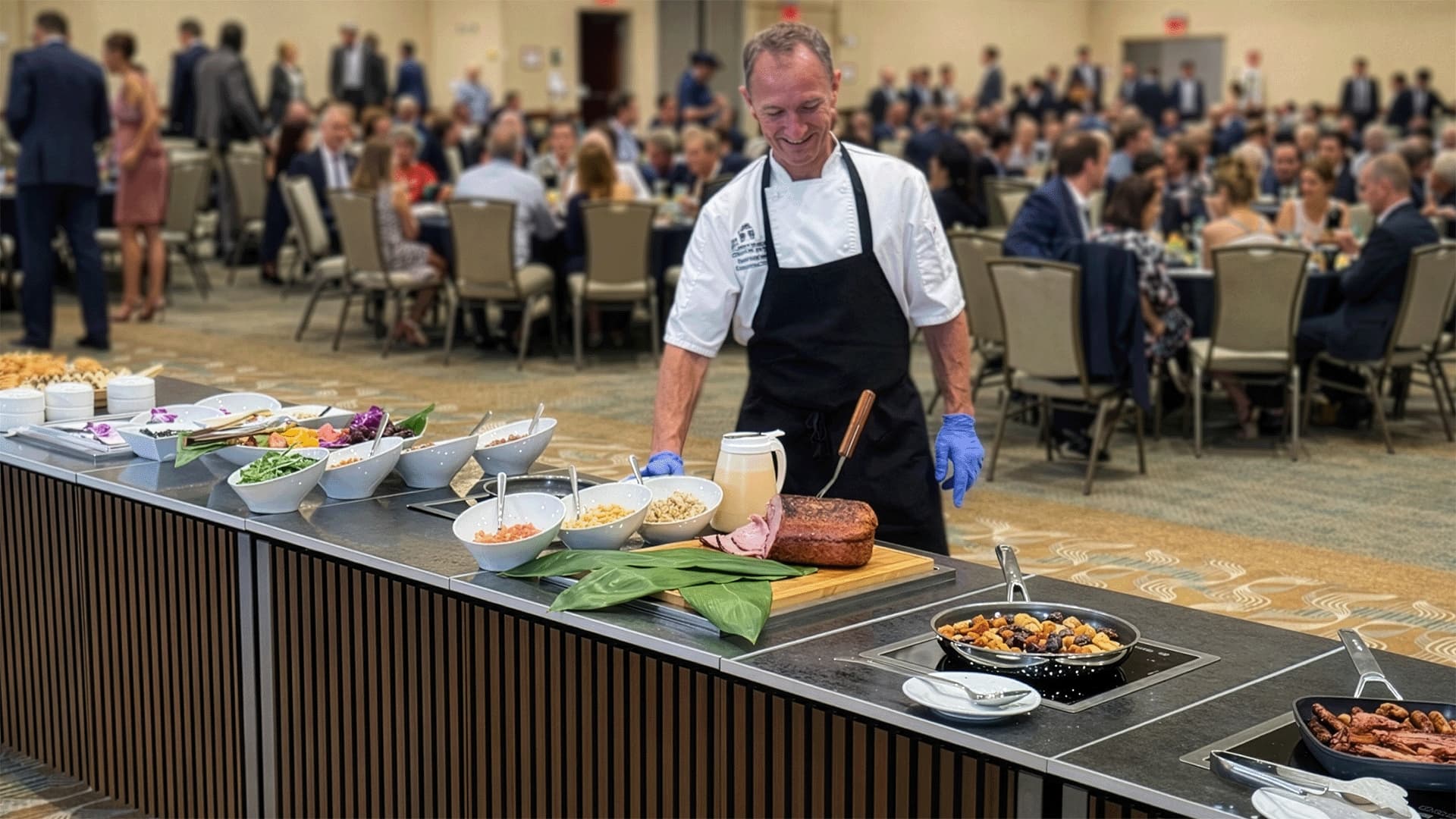
TRIO, their folding mobile action station, is the clearest example. A complete set delivers up to 18 linear feet of live cooking surface, enough to anchor a hotel banquet or a high-end buffet. After the event, the entire system folds onto a single transport and storage cart. Each station collapses from 30 inches wide to under 9. The stations, tiles, and panels all store together on one cart, where a comparable fixed setup would occupy a dedicated room.
The flexibility compounds the value. Interchangeable modular tiles let a single station handle warming, induction cooking, carving, or chilled seafood display, so one piece of equipment serves functions that used to require several. Fewer pieces, less storage, more use out of each one.
The equipment is not just smaller. It does the work of a larger inventory while occupying a fraction of the space, and it complements the venue aesthetically rather than compromising it, with trim options from wood veneer to slatted HPL.
The Reframe Worth Making
The takeaway is not about any single product. It is about how luxury operators value their own square footage.
Back-of-house storage is one of the few line items where a smart equipment decision directly converts dead space into usable, revenue-generating space. A property that reclaims a storage room gains an event space, a private dining nook, and a revenue line that did not exist before. The equipment pays for itself twice: once in what it does, and once in what it frees up.
The properties that understand this are not asking how much storage they need. They are asking how little they can get away with, and what they will do with everything they get back.
Forbes Industries is a Partner of the International Luxury Hotel Association. For more information, visit forbesindustries.com.