
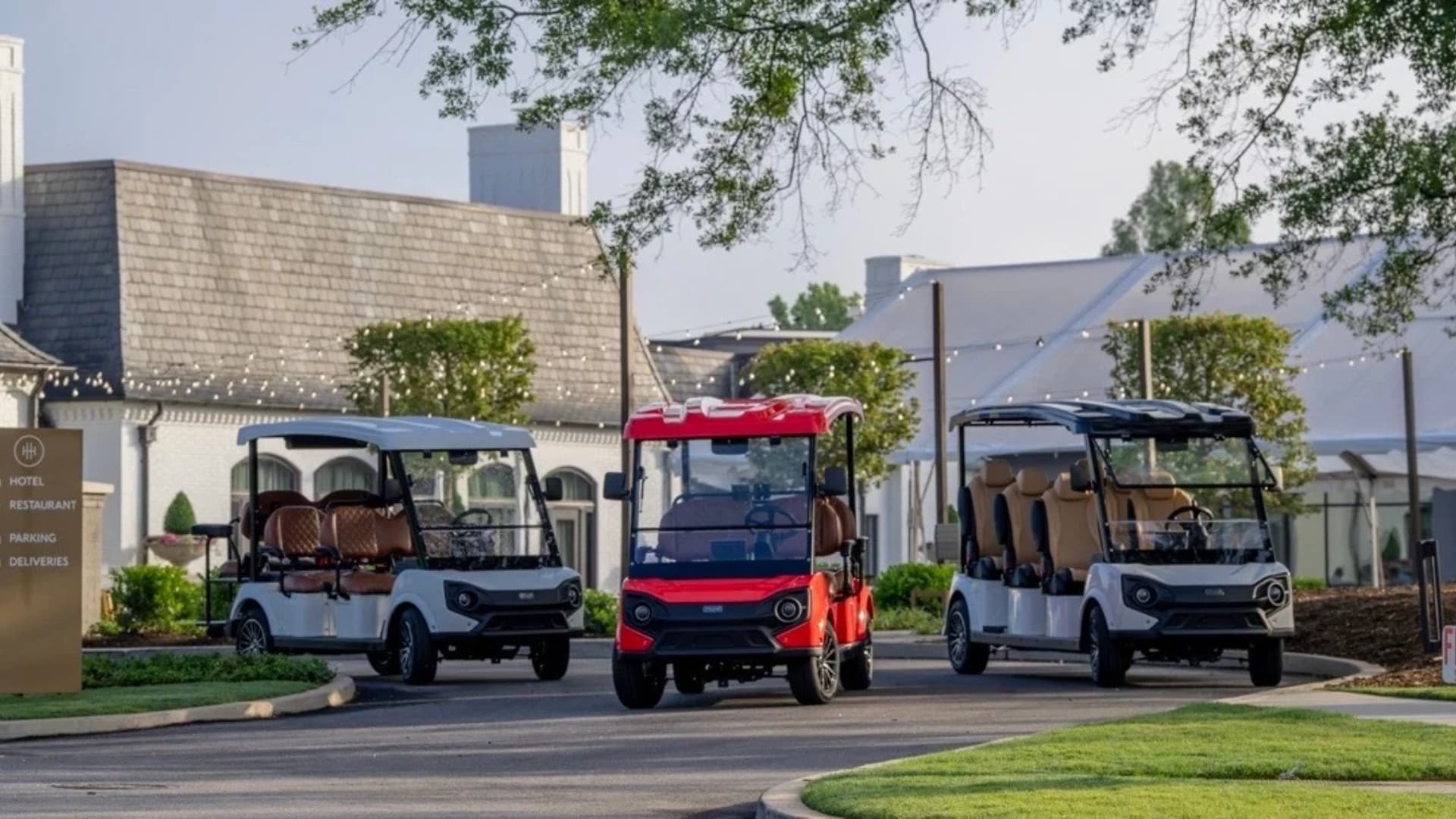
Why Durability Became a Frontline Concern in Luxury Guest Fleets
As luxury properties add electric vehicles to the guest experience, a quieter question is rising up the priority list: how well do they actually hold up? TAGO EV’s Sage Offutt explains why the real threats are not the obvious ones, why a fleet fails on appearance long before it fails mechanically, and why durability has become both a brand-standard and a bottom-line concern.
The Threat Is Not What Operators Expect
Ask what punishes a resort fleet, and most people picture salt air and sand. Sage Offutt of TAGO EV says the real culprit is something far more mundane, and far more relentless.
“What actually kills a resort fleet is the duty cycle,” she explains. “Drive half a mile to a mile, park, sit in the sun, half a mile back, forty times a day, by forty different drivers who’ve never operated a vehicle like this before. No vehicle in any other category lives like this.” It is the operation pattern, not the coastline, that wears a fleet down.
The Failures Come in Backwards Order
What surprises operators most is the order in which things go wrong. The first failures at a luxury property are not mechanical at all.
“The failures come in a predictable order, and it’s exactly backwards from what the operator wants,” Sage says. Rust blooms at the seatbelt fasteners, the steering wheel, and the bolts. The seat vinyl turns chalky within the first season. None of it stops the vehicle, and that is precisely the problem. As she puts it, “at a Five-Star property, a vehicle that looks old and finished gets retired whether the vehicle is finished or not.”
The same logic applies to how a vehicle feels. “A vehicle can photograph perfectly and feel cheap the second a guest sits in it,” Sage notes, “a rattle over the first seam, play in the steering, a seat that shifts under you.” Her point lands hard: “Nobody writes a spec against rattle, and rattle is the first thing a guest actually registers.”
There is a compounding effect at fleet scale. “Guests don’t notice a worn vehicle. They notice an inconsistent fleet,” Sage says. “One faded vehicle parked alone looks fine. Parked next to a newer one, it looks terrible.” That turns piecemeal replacement into a trap: the moment a property swaps out a few vehicles, every vehicle it did not replace gets visibly worse, not because anything changed, but because there is suddenly something to compare it to. A fleet is better replaced as a fleet, on a cycle, than patched one vehicle at a time as things fail.
The Care Routine Is Part of the Problem
There is a hidden accelerant most operators never account for: the effort to keep a fleet looking pristine is often what ages it fastest. A resort fleet gets washed constantly, frequently with pressure washers and harsh detergents, because it has to look presentable every morning.
“That drives water into bearings and connectors, strips coatings, and ages vinyl faster than sun does,” Sage says. “The routine that keeps a vehicle looking premium is quietly taking years off it, and almost nobody accounts for that when they’re evaluating one.” Unless a vehicle is built with sealed connectors and components that can take the water, the daily wash is working against the property.
What Durability Actually Comes Down To
The differences that determine whether a vehicle lasts are rarely visible on delivery. “It’s engineered components like stainless steel instead of plated, sealed connectors instead of open terminals, and bearings with actual seals,” Sage explains. “Each costs only a few dollars per vehicle, and each is what makes a year 3 vehicle look like a year 1 vehicle.”
She also argues operators track the wrong metric. “Operators ask how long a vehicle lasts, but the number that actually governs your season is how fast you can get a vehicle back into service. The person fixing it at a resort is the maintenance team, not a certified EV technician, so a vehicle that needs a specialist does not get repaired quickly. It gets parked, losing revenue for the resort in the peak months.”
The power system is the clearest example. “The battery failure you should worry about isn’t the one that’s dead in the garage,” Sage says. “It’s a guest who is two miles away at dinner, after dark, with a vehicle that said it had range, and it didn’t.” Chemistry decides it: lead-acid batteries deliver 300 to 400 cycles and four to six years, while lithium iron phosphate runs 2,000 to 3,500 cycles, roughly twelve years, with one lithium pack outlasting two to three lead-acid replacement cycles.
“Lead-acid is a false economy,” Sage says. “It’s cheaper once, and you buy it three times.” Lithium is indifferent to partial charging, the exact pattern that destroys lead-acid, and it holds voltage flat through the discharge. “Lead-acid gets weaker as it drains: slower up the hill, softer off the line. Your guest at twenty percent is driving a visibly worse vehicle than your guest at ninety, and neither of them knows why. With lithium, the last run of the day feels like the first.”
Durability Is a Financial Calculation
For an operator, durability ultimately shows up in uptime and cost, and both are concentrated in a few critical months. Utilization in these markets runs 80% or higher in peak season and drops to 15 to 20% off-season, and peak comes at a higher rate too. “A vehicle out of service in February costs you almost nothing. The same vehicle out for two weeks in July costs you more than all your winter downtime combined.”
That reliability gap hides a cost no one prices. “If you need 10 vehicles available on a July Saturday and your fleet is not reliable, you don’t actually own 10 vehicles. You own 12 and hope 10 work.” Over a fleet’s life, build quality moves every number, including residual value. “A well-built vehicle holds 55% to 70% of its value at three years,” Sage says, “where a poorly built one drops near 40%, a gap that can be worth more than everything you spent maintaining it.”
Where This Is Heading
Durability is also becoming a question of whether a property is even allowed to operate. The regulatory floor is rising, with states and cities adding registration, insurance, and annual safety inspections.
“Rust at the seatbelt anchors used to be an appearance problem,” Sage explains. “In a jurisdiction with an annual inspection, corroded seatbelt hardware or failed lighting isn’t an appearance problem anymore. It’s a registration problem. The vehicle doesn’t just look unfit, it’s not legal to operate.” Degradation is shifting from how a vehicle looks to whether it can be used at all.
What This Means for Luxury Properties
A guest vehicle is a brand asset and a financial one at the same time, and durability is what protects both. It governs how the fleet looks at the front door, how reliably it runs in the months that matter, and how much value it holds over its life.
Sage’s advice for any operator evaluating a fleet is straightforward. “Ask to see a three-year-old one. Not the brochure. Not the demo unit that came off the truck last week with the plastic still on the seats. A vehicle that’s been in service at a property like yours, in your climate, for three seasons.” Her reasoning is the real takeaway: “Every vendor in this category can show you a new vehicle. Very few will show you an old one. The ones who will are the ones worth talking to.”
TAGO EV is a Partner of the International Luxury Hotel Association. For more information, visit tagoev.com.
Related Articles

Spotlight ON: Jessica Gonzalez, VP of Hotel Operations at Harbour Village Bonaire
October 2026

Canouan Group Trains 34 Airport Professionals in Service Excellence
October 2026

Spotlight ON: Christian Glauser Benz, Senior Advisor & Brand Ambassador at Maybach Ocean Club
October 2026