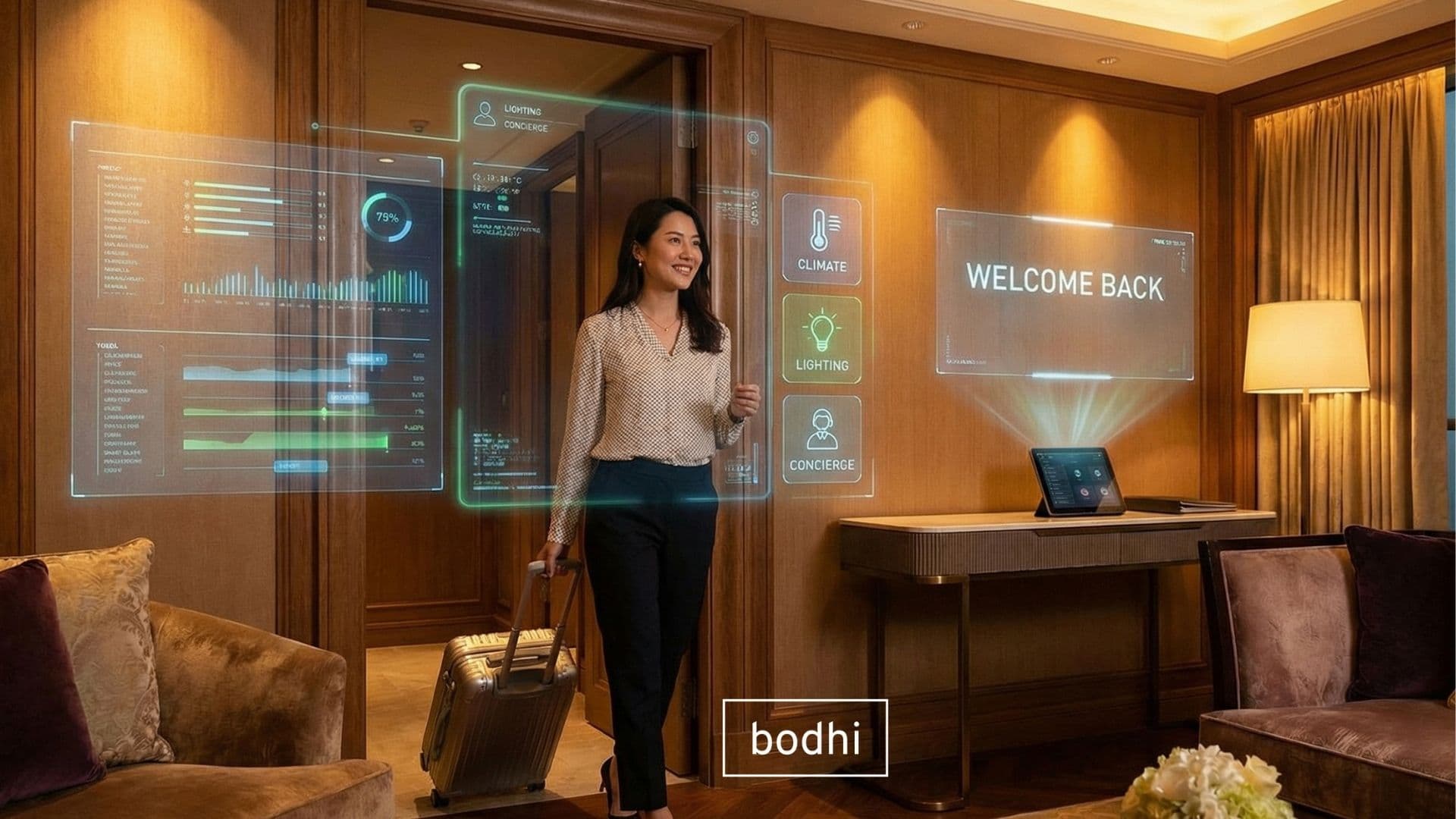

How AI books hotels: A guide for hotel operators
Artificial intelligence has become a primary channel through which travelers discover and book hotel rooms. SiteMinder's research indicates that eight in ten travelers now want AI assistance when researching their next stay, giving hospitality operators a clear signal to treat AI visibility as a distribution priority.
How Do AI Tools Book Hotels?
AI tools such as ChatGPT, Gemini, and Claude now present curated hotel options with live rates and availability directly inside a conversation. Depending on the tool, guests either follow a link to the hotel's own booking page or complete the reservation through an AI agent acting on their behalf.
What Is the Model Context Protocol, and Why Does It Matter for Distribution?
The Model Context Protocol, known as MCP, is an open standard that functions as a translator between hotel property systems and AI models. It replaces web scraping with real-time access to live rates and availability, which removes overbooking risk and keeps information accurate wherever an AI tool surfaces it.
How Do Guests Book Through AI Today?
Guests reach a hotel through AI in one of two ways. Direct guest-to-hotel booking sends a curated recommendation to the hotel's own booking engine, commission-free. AI-enabled intermediary booking has an AI agent select and complete the reservation on the traveler's behalf without further input. Agentic AI booking is still early, so the first path remains the more common one for now.
How Is SiteMinder Connecting Hotels to AI Booking Tools?
SiteMinder offers two paths into AI distribution. Direct Booking MCP extends a hotel's own booking website into large language models such as ChatGPT and Claude, and routes confirmed reservations back to the hotel's own booking engine. Channels Plus MCP adds properties to new AI channels automatically as they launch, syncing inventory on a commission-only basis.
How Can Hotels Get Discovered on AI Tools?
Hotels that want to appear in AI recommendations need to prioritize four practices: keeping rates and availability accurate and consistent across every channel, confirming their direct booking engine connections are functioning correctly, structuring property descriptions with clear headings, bulleted amenities, and precise location data, and favoring a smaller number of well-maintained channels over broad but incomplete distribution. AI search tools cross-reference data across the web to confirm that a business is accurate and trustworthy, so inconsistency in one channel can affect visibility everywhere.
What Does This Mean for the Future of Hotel Distribution?
Hotel distribution is moving toward an open, real-time data environment where AI recommendations reward properties with verified, well-structured information, alongside the paid advertising and search engine optimization operators already rely on. SiteMinder's 2026 Changing Traveller Report found that AI usage for accommodation research has grown nearly four times year on year, with adoption strongest in Asian markets. The report characterizes Chinese travelers as "AI-savvy" and Indonesian travelers as "AI-embracers." Distribution strategy is shifting from maximizing the number of listed channels toward building trust with AI tools through consistent, accurate data.
Frequently Asked Questions
Is AI booking the same as booking through an OTA?
No. Online travel agencies are third-party marketplaces that charge commissions of roughly 15 to 25 percent. AI tools function as conversational interfaces that interpret a guest's needs and surface relevant options, often routing back to the hotel's own booking engine.
Which AI tools can guests use to book a hotel?
Guests currently research and book through ChatGPT, Gemini, and Claude, while emerging agents from OpenAI's Operator, Akia, Bookline, and Virtualworkforce.ai handle more autonomous bookings on a traveler's behalf.
Do hotels need new technology to appear in AI results?
Not if they are already using a modern, integrated property management and distribution stack. The Model Context Protocol broadcasts live rates through existing systems rather than requiring a separate build.
How is AI hotel booking different from voice search?
Voice search converts spoken words into a standard search query. AI booking tools interpret intent directly and can complete a transaction without a traditional search step in between.
For hospitality operators and revenue leaders, the practical takeaway is straightforward. AI tools reward accurate, well-structured property data, and treating that data as a distribution priority now will shape visibility as adoption accelerates.