
Where Guests' Expectations Are Now: Connectivity and the New Standard of Luxury Service
What senior operators are learning about guest expectations, invisible revenue loss, and the infrastructure decisions shaping the next decade of luxury hospitality.
Luxury hospitality has always competed on experience. The quality of the mattress, the precision of the service, the design of the space. These are the variables the industry has spent decades refining. But a parallel variable, one that underpins every stage of the guest journey and is not often enough discussed at early stages of strategic planning, is how a property's connectivity infrastructure will now determine whether a guest returns, whether groups rebook, and whether AI-driven service investments can actually deliver.
In May 2026, ILHA convened a closed advisory committee in partnership with Strategic Venue Partners, bringing together senior operators, procurement executives, and technology consultants to examine what seamless connectivity means for luxury hospitality operations, and where the gap between guest expectation and property reality is most consequential.
The conversation covered five themes. All of them were operational today. None of them were theoretical.
The Expectation Is Flawless Connectivity: From Wi-Fi to Cellular
The committee opened with a point that required no debate: guests no longer distinguish between connectivity quality at a limited-service property and a Forbes Five-Star resort. The expectation is identical across segments, geographies, and guest types. Seamless connectivity, Wi-Fi and in-building cellular, is the baseline. It is not a luxury feature.
Ron Pohl of WorldHotels, whose portfolio spans 160+ upscale properties across multiple markets, described the operational reality: "It's an expectation. I was just at a meeting in Orlando last week; 500 people, and the Wi-Fi kept going down. How and why does this happen today? It just shouldn't. We've got to get the basics right."
The group also noted that charging guests separately for Wi-Fi connectivity, once a meaningful revenue line, is generating increasing friction. Guests at the luxury level view it as a contradiction in the service proposition.
It is a baseline expectation that guests should be able to use their cellular devices seamlessly across the resort, from subterranean amenity floors, through elevators and hallways, and especially in meeting and event spaces. This is where Wi-Fi falls short, and cellular becomes the mobility backbone of a resort's digital experience.
The Post-COVID Guest Cannot Be Segmented
The pandemic permanently dissolved the distinction between leisure and business travelers and with it, the ability to design connectivity around predictable usage patterns.
The leisure guest is on a Teams call. The business traveler is streaming. The family in the presidential suite has twelve devices active simultaneously. Properties still designing to segment assumptions are building to a guest who no longer exists.
Matt Baio of Xenios Group, a technology consultant with three decades in the industry: "It's just impossible to understand what people are going to do anymore. You have to design to the highest standard or highest common denominator."
That design imperative extends to personalization. Luxury guests expect the property to anticipate their preferences, remember their habits, and deliver without prompting. The challenge is that many are increasingly unwilling to provide the data that makes that possible, which renders the need for a property to offer highly secure cellular access, even in guest rooms where many believe Wi-Fi is sufficient.
Molly Preston of Pyramid Hospitality Group identified the tension precisely: "zEspecially in the luxury space, guests are wanting unfettered access without providing personal information. Their privacy matters. There's a real rub between the tech world, convenience, and personal data."
Jonas Niermann of Driftwood Capital described what resolution looks like from the guest's perspective: "Guests expect us to know what they want and what they don't. If they don't respond to pre-arrival outreach over two or three stays, they expect us to know, stop bothering them. It's the Amazon model: know my habits and stop making me repeat myself every stay."
Delivering that experience requires infrastructure that is seamless, invisible, and, from the guest's point of view, provides optionality based on each individual's security preferences.
The Event Space Is Where Revenue Disappears Quietly
For operators managing properties with significant group and events business, the committee identified a specific and underappreciated risk: connectivity failures in meeting spaces do not generate complaints. They generate attrition that never surfaces in reporting.
Meeting planners evaluate properties during RFP site visits. The connectivity experience in those walkthroughs is a hard filter. A property with weak cellular coverage or inconsistent event Wi-Fi is removed from consideration silently and permanently, with no feedback provided.
“You have meeting planners doing pre-sites during the RFP process, walking through the building. If they don't have a seamless experience during their review, they're going to eliminate your venue and you will never know why you lost that business.”
The operational implication is direct: protecting group revenue is not only a sales and marketing challenge. It is an infrastructure investment decision. Properties that have not allocated capital to ensure flawless connectivity in meeting and event spaces are carrying a revenue risk that does not appear in their reporting until the bookings stop coming.
The same principle applies to staff operations in event environments. As AI-assisted tools take on more of the operational load, including housekeeping coordination, event setup communications, and real-time service dispatch, network reliability in transitional and back-of-house spaces becomes a direct determinant of service quality.
“Places that we didn't maybe care about that long ago, hallways, pre-function spaces, those spaces matter. The network has to work seamlessly for back-of-house and for guests everywhere.”
Mobile-First Is the Operating Model
The committee reached consensus on where the operational center of gravity is moving: the mobile device is the primary interface for every stage of the guest journey, and every other technology decision cascades from it.
Ron Pohl articulated the strategic sequence: base everything on the mobile device first, then layer IoT-driven sustainability, smart room controls, and AI-assisted service on top. The mobile device is not one channel among many. It is the platform through which every other capability is accessed by the guest, and increasingly by staff.
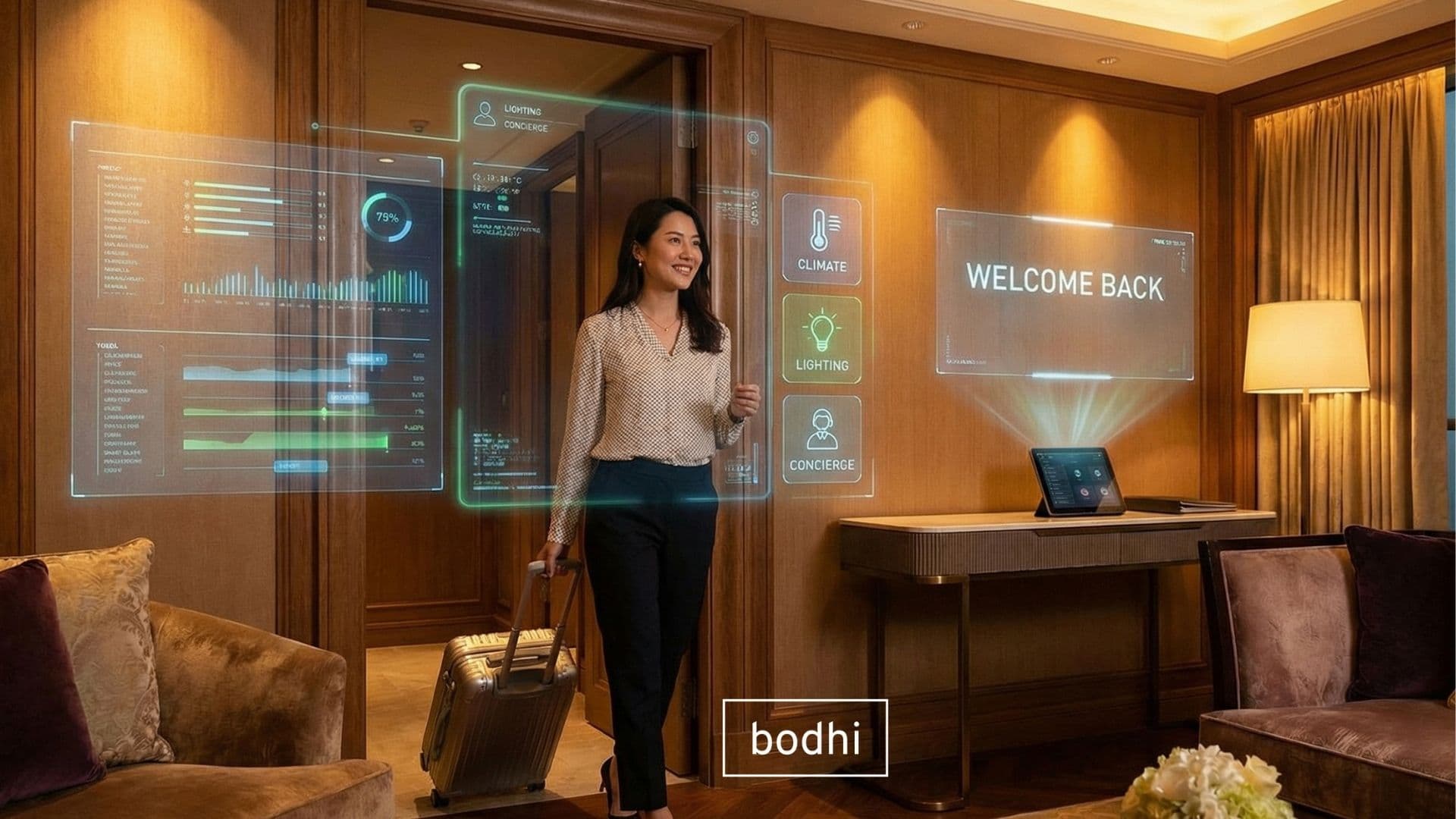
Smart room capabilities, including lighting, climate, personalization, and keyless entry, require not just reliable Wi-Fi but consistent cellular coverage throughout the property. Mobile concierge, pre-arrival communication, and in-stay service requests all depend on the same infrastructure. A gap anywhere in the network is a gap in the service model.
Page Petry, former CIO of Marriott Americas, framed the strategic imperative for operators:
“There's no other component in a hotel budget that plays across every single step of the guest journey, from the time the person books to check-in to check-out. We really need to be talking about it very differently, not so much that it has to work, but that it's fundamental to the success of a hotel.”
Keeping Connectivity Invisible Is the Standard
This is where Strategic Venue Partners enters the conversation. The premise of their work in luxury hospitality is straightforward: connectivity should never be something a guest notices, troubleshoots, or thinks about. It should be as invisible as the plumbing and as reliable as the power, present everywhere, performing under any condition, and ready for whatever the next wave of guest-facing and operational technology demands.
For operators, that means working with a connectivity specialist, the earlier the better, who understands the specific environments luxury properties operate in, from high-density ballroom events to sprawling resort grounds to the back-of-house corridors where staff tools now run continuously. Strategic Venue Partners designs, implements, monitors, maintains, and consistently upgrades the infrastructure that makes seamless guest experience possible.
What Operators Are Prioritizing Now
The committee's operational guidance for property and regional leadership concentrated around three immediate priorities.
Design to the highest common denominator. Segmentation-based connectivity design is no longer viable. Every guest, in every space, requires the same quality of access.
Treat event and meeting spaces as the highest-stakes connectivity environment on property. The revenue exposure from group business lost during site visits is real, material, and invisible in standard reporting. It requires proactive investment.
Partner with dedicated technology specialists rather than attempting to build or manage connectivity internally.
“At the end of the day, we're hotel people, we're not technology people. We identify who we want to partner with to provide that across all of our brands. We're no longer trying to create the guest messaging platform, we're going to partner with who we think is best in business.”
The guest experience the luxury industry is competing to deliver, personalized, seamless, and anticipatory, runs entirely on this infrastructure. Properties that treat connectivity as a background cost are building on a foundation that will not hold the weight of what comes next.
This article was produced from the ILHA Advisory Committee session held on May 20, 2026, in partnership with Strategic Venue Partners. The committee was convened to examine connectivity priorities among senior luxury hospitality operators, owners, and asset managers. A second advisory session is planned for approximately two months out.
To learn how Strategic Venue Partners delivers connectivity infrastructure for luxury hospitality, visit strategicvenue.com.