What We've Been Talking About: A Look at Recent International Luxury Hotel Association Webinars
The conversation around luxury hospitality is getting more specific and more interesting. Over the past month, the ILHA webinar series has covered a range of topics that don't always share the same stage: retail as a guest experience strategy, the beverage program as a brand statement, pre-arrival personalization, and the design philosophy behind a luxury guest room. Below is a look at what came out of each conversation, and where to watch the full recording.
Wearable Art and the Case for Pre-Owned Luxury
Seth Weisser, CEO of What Goes Around Comes Around, in conversation with Michelle McLean, Former Miss Universe and International Business Officer, North America, Gondwana Collection, Namibia
Seth Weisser has been building the case for vintage luxury longer than most people have considered it a legitimate category. He co-founded What Goes Around Comes Around in New York in 1993, before "pre-owned" was a marketing term, and has spent three decades watching the market shift toward exactly what he was doing first.
His conversation with Michelle McLean, moderated for an ILHA audience, made a clear argument: curated vintage belongs in luxury hospitality. Not as a novelty, but as a genuine guest experience strategy. The logic is straightforward. Guests at luxury properties are already in a spending mindset, often celebrating an occasion, and increasingly looking for something they can't find anywhere else. A rare Chanel bag or discontinued Rolex carries a different kind of story than anything available at retail and that story, Weisser argued, becomes part of the memory of the stay itself.
WGACA now works with partners across cruise lines, resort groups, and hotel collections, including the Ritz-Carlton Yacht Collection and Disney, and Weisser described what drives conversion in those settings: front-line training, authentication that guests can verify themselves, and a product mix calibrated to the specific guest profile of each property. For properties hosting PGA events, conference weeks, or anniversary travel, the opportunity is there to pre-position inventory before the guest even arrives.
The sustainability angle matters too. Pre-owned luxury is, by nature, a circular model and for properties with sustainability commitments, that's a genuine alignment, not a stretch.
The Beverage Program as a Destination
Francesco Lafranconi, Vice President of Beverage and Hospitality Culture, Carver Road Hospitality, and Matt Sielsky, Vice President of Global Accounts, Forbes Industries. Moderated by Barak Hirschowitz, President, International Luxury Hotel Association.
Barak Hirschowitz, who moderated the conversation and has seen the Carver Steak program firsthand, set the frame early: "What started as a bar menu has become something much more powerful. It's a cultural statement, a guest retention tool, and in the right hands, a meaningful contributor to your hotel's bottom line." He came to the topic with an F&B background himself, and that informed the conversation throughout, particularly his observation that tableside service, which was central to luxury hospitality for generations, is having a meaningful and necessary comeback.
Francesco Lafranconi opened with a statement worth writing down: "The bar is not an accessory to the steakhouse." It's a destination in its own right, one that can drive reservations independently, justify premium spend, and create the kind of moment a guest tells someone about the next morning.
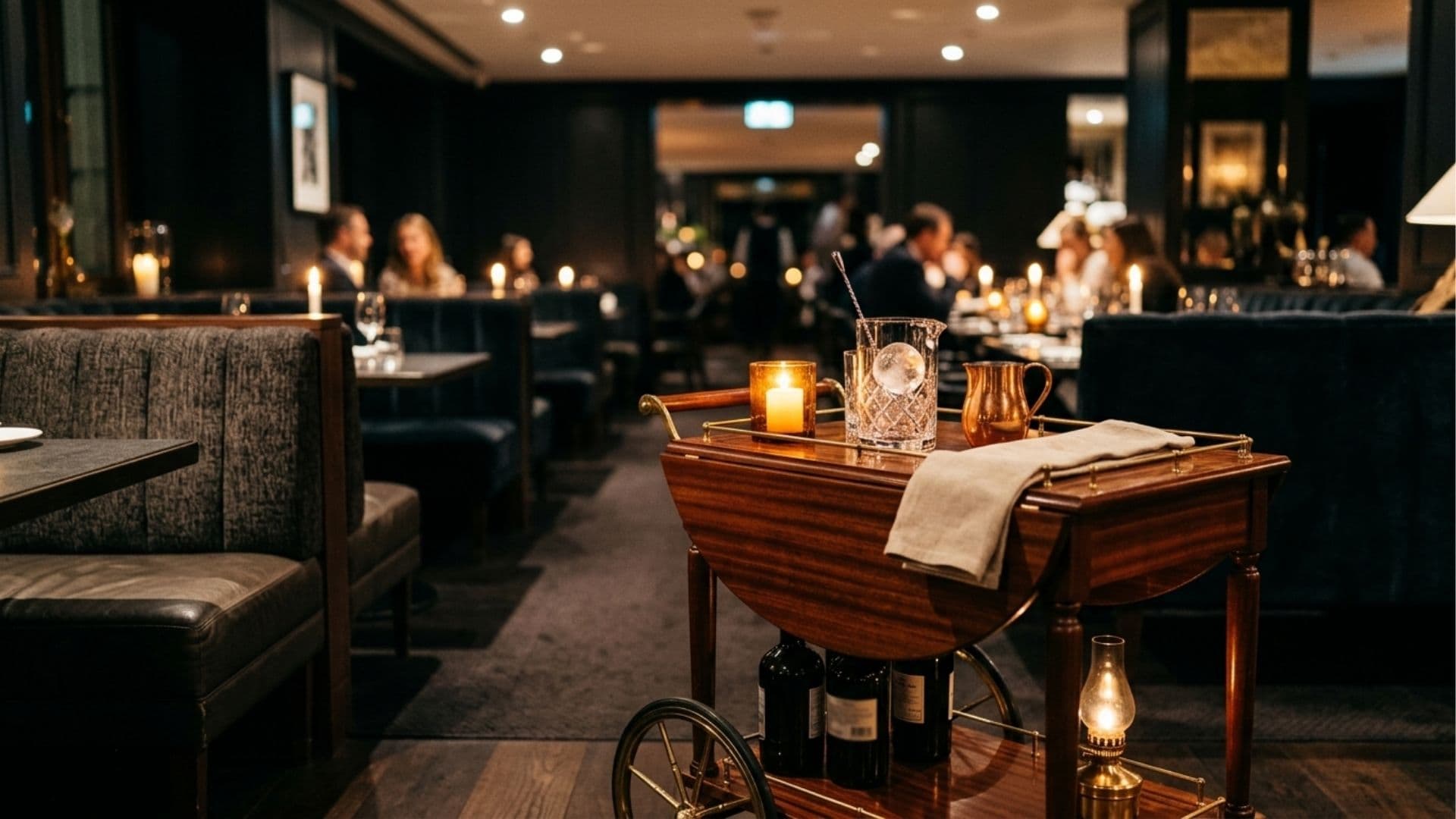
Lafranconi oversees the beverage program at Carver Steak, which recently expanded from Resorts World Las Vegas to a new location in Midtown Manhattan. The program is built around what he calls theatrical service: cocktail carts that come to the table, servers trained in the synchronized, deliberate choreography of making a drink in front of a guest. The 90-second performance of a tableside old-fashioned, the coordinated pour, the squeezed lemon peel, the custom old-fashioned blend with smoked tea and maple syrup, is not incidental. It is the product.
Matt Sielsky of Forbes Industries, which designs and manufactures the custom service equipment behind programs like this, made a point that connected directly: the experience only works when all three elements are present. The right person. The right drink. The right cart. Remove any one of them and the magic dissolves. Hotels and restaurants willing to invest in all three, he noted, consistently see the ROI in repeat guests and increased per-cover spend.
Both Lafranconi and Sielsky saw the same underutilized opportunity: banquet and event space. The cocktail cart model scales. A bruschetta cart, a caviar and sparkling wine service, a mobile oyster bar, formats that bring the experience to the guest rather than asking them to leave the conversation and stand in line, translate directly to events, and most properties haven't touched that category yet.
Owning the Guest Before They Arrive
Robert Charlock, Director of Revenue Management, One & Only Moonlight Basin, and Dan Hiza, VP of Business Development for Hospitality Upselling, Plusgrade
One & Only Moonlight Basin opened in Big Sky, Montana, as the brand's first alpine resort in the United States. The property spans 240 acres and is built around the same principle One & Only has applied globally: deeply personalized service, a strong sense of place, and experiences designed around the guest rather than a program. Robert Charlock, who manages revenue strategy there, joined Dan Hiza of Plusgrade to discuss what happens between booking and arrival and why most properties are leaving that window almost entirely unused.
The central idea: "Control is the new luxury." Ultra-luxury guests don't want to arrive and start figuring out their stay. They want to have shaped it in advance, chosen the room, secured the experience, made the itinerary feel like theirs. When that happens pre-arrival, guests arrive differently. More emotionally attached. More ready to enjoy. And on-property teams spend less time negotiating logistics and more time on presence and connection.
Plusgrade's platform enables this through upgrade offers designed to feel like invitations rather than sales prompts. The framing matters enormously. "Wake up to your exclusive mountain view" converts better than a price-forward message. A bidding mechanism, where guests choose what they're willing to pay within a set range, adds an element of agency that resonates particularly well in the luxury segment. The guest who places a bid and wins it feels a quiet satisfaction that carries into their stay.
Charlock described One & Only's pre-arrival process as a relationship-building moment, not an administrative one. Each guest is connected with a dedicated host before arrival. A detailed itinerary is drafted around their interests, whether that's a private gondola to the ski resort, fly fishing, stargazing with an astronomy professor at the on-property observatory, or a snowmobile trip through Yellowstone. By the time the guest arrives, the host already knows what matters to them.
The check-in itself reflects that. No front-desk transaction. A branding ceremony where guests mark their own piece of wood with an initial or symbol to take home. A welcome drink and a hot towel before being escorted directly to the room. The stay has already begun before the bags are unpacked.
What a Luxury Guest Room Actually Has to Do
Miriam Torres, Co-Owner, Parker Torres Design; Matthew O'Malley, Senior Director of Procurement, Projects and Design, La Estancia; and Frank Boardman, Principal, Mittman Hospitality. Moderated by Stacy Shoemaker-Rauen, Co-Founder, Stay and Gather.
Miriam Torres said something that stuck: she wants people to text her later and say, do you do this room? That's the benchmark. Not a good review. Not a social media post. A message from a guest who remembered.
The conversation, moderated by Stacy Shoemaker-Rauen, covered what a luxury guest room actually has to accomplish and it's more than good design. Matthew O'Malley, who oversees design and procurement at La Estancia and works with ownership to translate brand culture into physical space, framed it through a concept he called "the neuroscience of tangibility." The pen should have weight. The cup should feel substantial. The towel should carry a detail that makes a guest pause. None of it is accidental. All of it communicates that someone cared.
Frank Boardman of Mittman Hospitality, which manufactures custom furniture for luxury properties, brought the manufacturing perspective: the chair has to sit right. The drawer has to open smoothly. The credenza has to give everything its place. Effortlessness, when done well, is the result of a great deal of effort applied invisibly.
The group pushed back on the idea that luxury means minimal. O'Malley mentioned the designers and influencers declaring the end of minimalism and noted that for luxury specifically, what matters is layering with intention. A room that has story and texture and a few genuine wow moments is more memorable than one that disappears into the background. Torres described a current project where a magnolia flower pendant serves as the one element in an otherwise serene room that guests will take home in their memory.
The practical conversation was equally useful. Blackout drapery for international travelers resetting their circadian rhythms. Outlet placement that doesn't look like a rocket panel. Power hidden in a nightstand drawer with a small brass tag. The CPAP machine on the nightstand that tells a well-trained housekeeping team to leave a bottle of distilled water. Turndown service that some operators have eliminated and shouldn't.
The through line was collaboration. Good design that doesn't hold up. Furniture that looks right but doesn't work operationally. Technology that requires a phone call to the front desk. Any one of those is enough to break the memory a guest would otherwise have taken home.
All International Luxury Hotel Association webinar recordings are available at ILHA.org under the Discover tab.
Featured Organizations