
The New Luxury Calculus: Revenue, Technology, and the Art of Knowing When to Step Back
The International Luxury Hotel Association's April Webinar Series tackles the questions luxury operators are wrestling with right now
This April, the International Luxury Hotel Association is bringing those conversations into the open. Across three webinars, How Luxury Hotels Are Reimagining F&B as an Ancillary Revenue Driver, Rethinking Resort Fees: Guest Perception and Commercial ROI, and Optimizing AI in Operations Without Losing the Human Touch. Executives from Viceroy Hotels and Resorts, HEI Hotels and Resorts, Eight Form, IRIS Software Systems, FCS Solutions, Snap Wellness, and Naturally Pacific Resort will get into the specifics: what's working, what isn't, and where the real opportunities are being missed.
Here's a preview.
The F&B Opportunity Most Hotels Are Still Leaving on the Table
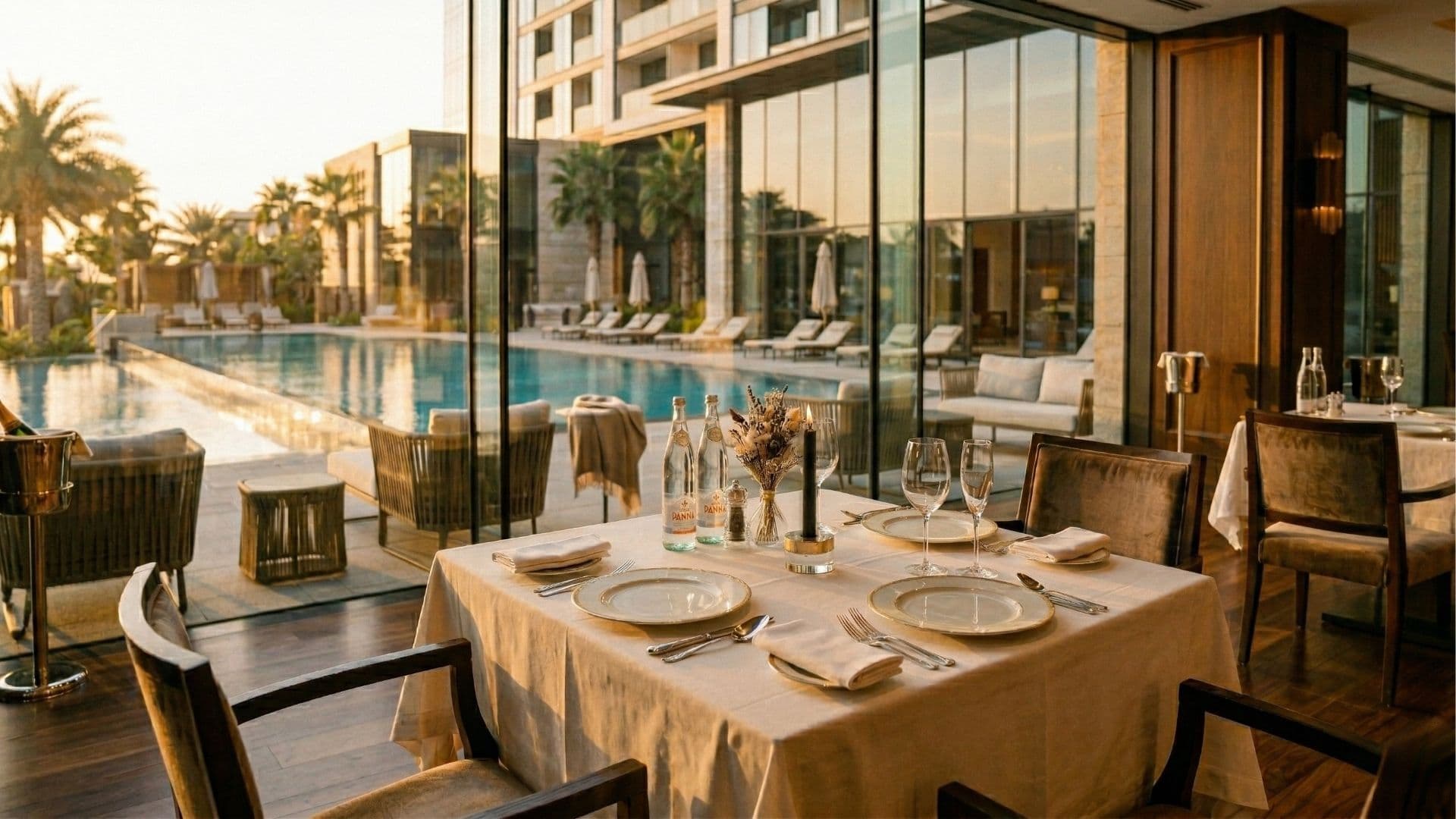
Eating in a hotel restaurant has become one of the most significant revenue opportunities in the luxury segment today. Hotel restaurants with the right chef, concept, and activation are drawing local communities, generating their own press, and, as Zach Demuth, Head of Strategic Growth and Asset Management at Eight Form, confirmed through JLL research, demonstrably lifting a hotel's room rate. The dining room has become a pricing lever.
The urgency is real. With room rates broadly plateauing, F&B has become the most accessible frontier for incremental revenue, and mobile ordering is turning previously invisible spaces into productive ones: the tucked-away lobby nook, the pool deck before full staffing begins, the pre-arrival window when a guest is still at home. But Aliyah Kritzler of HEI Hotels and Resorts is quick to set the standard.
"Every space has untapped opportunity. The responsibility is making sure the guest ordering from that corner of the lobby gets the same quality of experience as someone sitting at the bar."
As she mentioned in our webinar: How Luxury Hotels Are Reimagining F&B as an Ancillary Revenue Driver
The deeper insight is about psychology. Kritzler's teams have found that guests are measurably more likely to order a full bottle of wine through a mobile platform than when speaking to a room service attendant out loud. Remove the social friction and spend goes up. Every digital order also becomes a data point.
"I now know Mr. Smith prefers Cabernet over Pinot Noir," she said. "So his next arrival amenity changes. The technology is building our CRM."
"Time and efficiency is luxury. Being able to provide something to a guest efficiently, in the way they want to receive it, that is a luxury experience."
Aliyah Kritzler, Group VP of Food & Beverage, HEI Hotels and Resorts
The Resort Fee Has Become a Brand Statement
Patrick Pahlke, Chief Commercial Officer, Viceroy Hotels and Resorts, is refreshingly direct about the resort fee's origins in the webinar: Rethinking Resort Fees: Guest Perception and Commercial ROI.
"It was a non-commissionable tax that guests accepted totally against their will."
Today, guests perform what he calls a "cost-to-joy ratio" calculation at check-in, and the verdict shapes how they feel about the entire stay. A fee that covers Wi-Fi and local calls doesn't just underwhelm; it actively damages trust. A fee that covers a shuttle to a private beach, a sunscreen station, and a beach concierge creates the opposite effect: guests feel they've come out ahead before they've unpacked.
Michael Johnstone, General Manager of Naturally Pacific Resort inherited a fee built around Wi-Fi and parking. His team went back to first principles and found the answer growing in the hotel's own garden.
"We introduced tours with the executive chef and head horticulturalist. Complaints about the resort fee dropped to almost nothing."
By last summer the resort had built 21 inclusions, most of them asset-light: a 15-minute lesson with the golf pro, complimentary bikes, a manager's cocktail hour. A dollar from every resort fee went to the local food bank, raising nearly $12,000.
"It didn't hurt my profit line at all," Johnstone said. "But it meant something."
The right inclusion also drives spend elsewhere. Resorts using Snap Wellness's sunscreen booths have seen a 31% increase in poolside F&B spend, simply because guests who aren't sunburned stay outside longer. Organic guest content from one property generated what founder Kristen McClellan estimates would have cost $8 to $11 million in influencer marketing. Pahlke applies a clean test at Viceroy: if a mezcal tasting converts into full-bottle bar sales in the hour that follows, it stays. If a spa inclusion drives a measurable uptick in massage bookings, it stays. Everything else is up for review.
AI in Luxury Operations: The Honest Conversation
Most conversations about AI in hospitality land in one of two places: uncritical enthusiasm or reflexive skepticism. The operators getting real results have moved past both.
The practical case is solid. AI-driven call handling is reducing front-desk call volume by 40% to 80% at properties where it's been deployed. Operational savings of 20% to 30% are being reported. Housekeeping scheduling, maintenance routing, and revenue forecasting are all improving in speed and consistency. But the more important insight, offered consistently by Chet Patel, Complex Director of IT of Caribe Royale Orlando and his peers, is about what happens to the humans when the routine is handled.
"The empathy, the intuition, making a guest feel truly cared for, those can only come from a human being. What AI gives you is the data to deliver those things better."
A staff member who knows a guest checked in at 3 a.m. can calibrate their morning interaction. A hostess who knows a returning guest's dining preferences before they reach the podium delivers something that feels like genuine attentiveness.
As Mahwish Saleem of FCS Solutions shares in the Optimizing AI in Operations without Losing the Human Touch webinar:
"AI handles speed and scale. Humans handle emotion and judgment. AI can capture a complaint and log the details. A person resolves it, empathizes, and recovers the experience. AI can support the interaction. It shouldn't own the relationship."
"The goal is to let technology automate the predictable, so that humans can humanize the exceptional."
Zach Demuth, Head of Strategic Growth and Asset Management, Eight Form
There is a workforce dimension to this that is easy to underestimate. Kritzler has found that well-deployed technology accelerates career development, helping entry-level employees learn across departments faster and make meaningful decisions earlier. In a labor market that continues to punish hotels that can't retain talent, that matters as much as any efficiency gain.
The Standard That Hasn't Changed
Beneath all of this, the ambition remains exactly what it has always been. Kritzler puts it simply:
"Some of the best service is service you don't remember, because it was so seamless that you remember the experience far over the act of being served."
The tools available to deliver that have never been more powerful. The standard has never moved.
Don’t miss the ILHA April webinar series, it will explore, in sharper detail, how today's operators are building the systems, culture, and technology to make it consistently possible.
Featured Organizations








Related Articles

How Amadeus and HyperGuest Are Reshaping Leisure Hotel Distribution
October 2026
Spotlight ON: Christian Glauser Benz, Senior Advisor & Brand Ambassador at Maybach Ocean Club
October 2026
7 F&B Budget Priorities to Turn Your Hotel F&B From Amenity to Main Revenue Driver in 2027
September 2026